Encyclopedia · Photochemical step
UV exposure
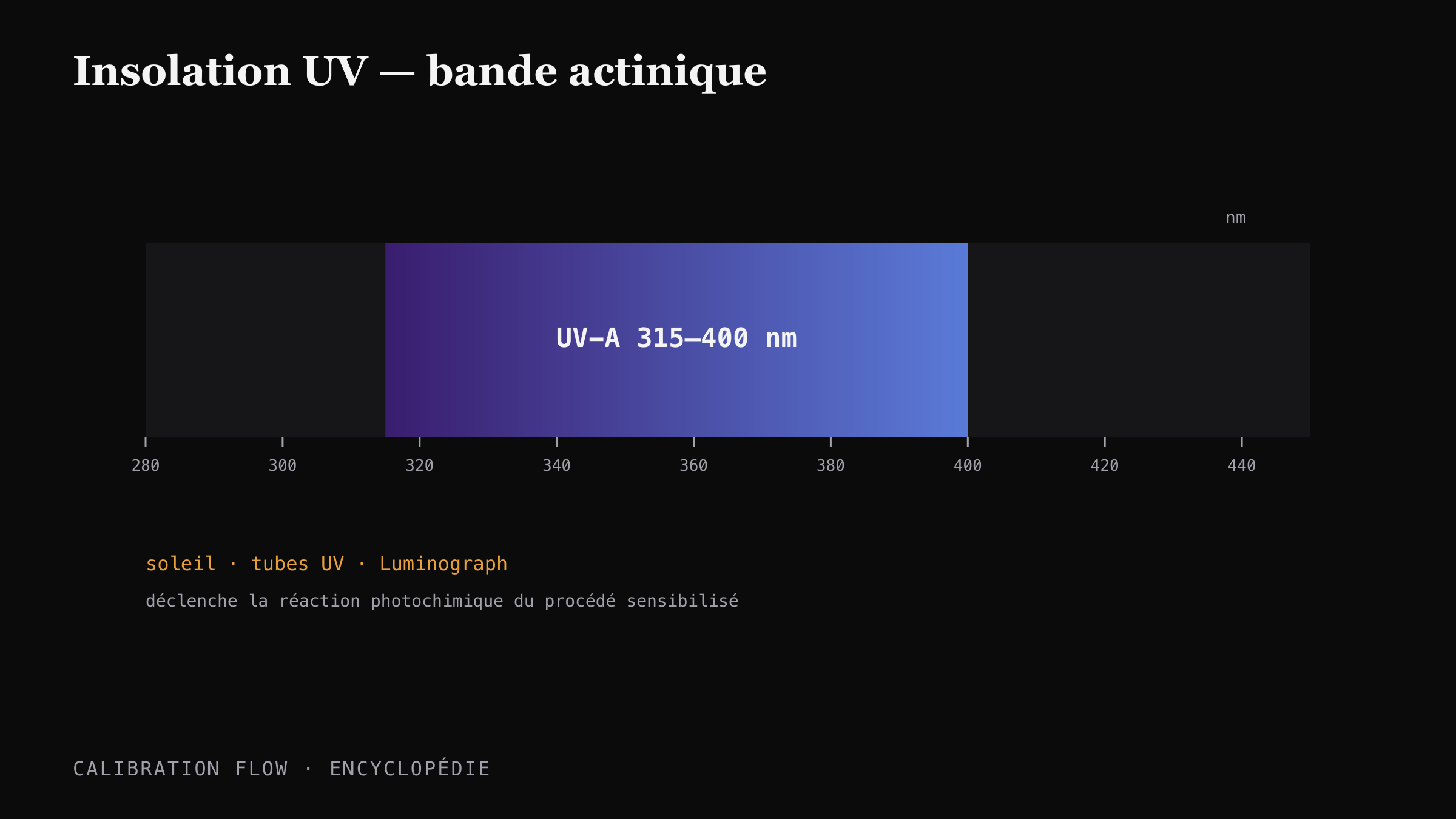
UV exposure is exposing a sensitised paper to ultraviolet rays — mainly UV-A, wavelengths from 315 to 400 nm — that trigger the photochemical reaction of an alternative process. Its duration ranges from a few minutes to over an hour, depending on process, UV source and negative density.
Verified on 2026-05-19 by the Calibration Flow team.
Context and history
UV exposure is the direct heir of the sunlight used by 19th-century pioneers. John Herschel invented the cyanotype in 1842 by exposing his sheets in full sun for 5 to 15 minutes; William Willis patented platinotype in 1873 with times of 10 to 30 minutes; Joseph Wilson Swan filed carbon in 1864 on the same principles.
The 20th century saw the arrival of UV-A fluorescent tubes (BL/BLB), then in the 2010s UV-A LED panels at 365 nm and 395 nm, which now replace the sun in most workshops. Christopher James, in The Book of Alternative Process Photography, and Bostick & Sullivan documented precisely the expected times for each process by UV source.
How UV exposure works
The sensitisers of alternative processes (ferric citrate, ferric oxalate, silver salts, dichromate, bichromate or non-toxic substitutes) absorb the energy of a UV photon and trigger a chemical reduction. Three variables govern the exposure time:
- Source spectrum — a process is mostly sensitive to UV-A (315-400 nm). A source whose emission peak is at 365 nm is more efficient than a 395 nm source for most ferric processes.
- Irradiance — the amount of UV received per cm² per second (mW/cm²). Zenithal summer sun exceeds 5 mW/cm² in UV-A; a bank of BL tubes runs around 2-4 mW/cm² at 10 cm; the Luminograph A4 delivers a stable irradiance around 8-12 mW/cm², uniform across the surface.
- Negative density — the negative’s tonal range (Dmin → Dmax) defines how much UV passes through each zone. A denser negative better protects the highlights and proportionally lengthens the exposure time.
The reciprocity law roughly holds on ferric processes (cyanotype, Van Dyke, platinotype): doubling the exposure time is like doubling the intensity received. On hardening processes (gum bichromate, carbon), reciprocity failure at low intensities can require 10-30% extra time in indirect light.
UV exposure in Calibration Flow
Calibration Flow does not directly measure UV light — it is not a light meter. The tool records the exposure time in the preset attached to each calibration, which lets you reproduce a print identically as long as the UV source stays the same.
When the source changes (sun → tubes, or ageing tubes → new tubes), the correction curve stays valid but the exposure time must be readjusted with a test print across a range of durations. The curve absorbs the process non-linearity; the exposure time simply calibrates the overall level of energy received.
Typical exposure times by process and source
Orders of magnitude observed on a standard negative. Always validate with a test print before the session.
| Process | Zenithal sun | UV-A tubes (4×40 W) | Luminograph A4 |
|---|---|---|---|
| Cyanotype | 5 — 15 min | 8 — 20 min | 3 — 8 min |
| Van Dyke | 8 — 20 min | 12 — 30 min | 5 — 12 min |
| Platinum/Palladium | 10 — 30 min | 15 — 40 min | 8 — 18 min |
| Gum bichromate (per layer) | 3 — 10 min | 5 — 15 min | 2 — 6 min |
| Carbon (per transfer) | 2 — 8 min | 4 — 12 min | 2 — 5 min |
Sources: Christopher James (The Book of Alternative Process Photography) and Bostick & Sullivan datasheets, cross-checked with Vision Picturale workshop observations.
Sources and references
- Christopher James, The Book of Alternative Process Photography, 3rd edition — academic reference on exposure times by process.
- Bostick & Sullivan — online datasheets: bostick-sullivan.com.
- Wikipedia — Ultraviolet: en.wikipedia.org/wiki/Ultraviolet.
- AlternativePhotography.com — articles on UV exposure in cyanotype and platinotype: alternativephotography.com.
Go further
- Calibrate a cyanotype — process page that uses these times.
- UV printing — overview.
- Glossary — UV terms.
- Discover the Luminograph (stable A4 / A3+ UV source).