Thirty-two terms that come up in the practice of alternative processes and in Calibration Flow. Each with its definition, its English equivalent and a link to the pages where the concept is used.
The order is alphabetical by the French term.
#ACV (.acv)
Adobe Curves. Adobe's proprietary format for storing a tonal response curve, read natively by Photoshop (Curves panel → Load) and indirectly by Lightroom (via a Photoshop preset). A binary format in version 1, with up to 16 curve points stored as 16-bit big-endian integers. Calibration Flow exports .acv files that resample the internal 256-value LUT down to the number of points the format allows — export reserved for Pro mode. The final file fits in under one kilobyte.
See also: ACV export for Photoshop, ACV export for Lightroom.
#Aquaprint
Vision Picturale's proprietary name for gum bichromate (dichromated gum), practiced bichromate-free: powder pigments in a gum arabic base and a non-toxic sensitizer, pre-dosed together in the Aquaprint pouches — the sensitizer is no longer sold on its own. Developed with VP N°03 Développeur (hydrogen peroxide); VP N°04 Primaire Universelle primes papers other than PULPØ. Four variants: Mono (black), Sanguine (yellow, ochre, red), CMYK (4 pouches C/M/Y/K) and Gamut (7 pouches, including green, purple and orange). Generic English equivalent: gum printing. See https://en.wikipedia.org/wiki/Gum_printing.
See also: CMYK four-colour.
#Bichromate
A chemical salt (potassium dichromate, ammonium dichromate) historically used to sensitize gum arabic or gelatin to UV — the hexavalent chromium it contains is classified CMR (carcinogenic, mutagenic, toxic to reproduction). It's the shared toxic point of traditional gum bichromate, carbon, bromoil and résinotype. Vision Picturale has removed it from Aquaprint (its non-toxic take on gum bichromate), from bromoil and from résinotype: the non-toxic sensitizer that replaces it is now pre-dosed directly in the pouches, with no separate sale. Charbon Mono's chemistry, still being finalized at Vision Picturale, isn't documented as non-toxic.
#Alignment (registration)
The operation of positioning the scanned test chart inside Calibration Flow's reference frame so the app knows where to measure each patch. Done by finger (drag, pinch). The Smart Analyzer does not align the chart: it classifies the imported image's tonal intent — it doesn't detect patches or handle alignment, which are separate functions.
See also: Smart Analyzer.
#Charbon (carbon transfer)
A traditional pigment process invented by Joseph Wilson Swan in 1864: a sheet of pigmented gelatin tissue is sensitized, exposed, then transferred and developed in warm water — known for very deep blacks and a slight matte bas-relief in raking light. At Vision Picturale, only the Charbon Mono kit is still offered, shown as "in production" and not yet on sale: its development chemistry isn't settled yet and no dMax is confirmed to date. The colour kits (Sanguine, CMYK, Gamut) were withdrawn from the range in favour of Aquaprint: "Aquaprint, the perfect compromise between gum bichromate printing and carbon printing — the pictorial texture of gum, the depth of carbon, without dichromate." Maison Picturale prints carbon on request. Calibration Flow calibrates it like any other process: one curve in monochrome, four C/M/Y/K curves in colour. See https://en.wikipedia.org/wiki/Carbon_print.
See also: CMYK four-colour, Registration marks.
#CMY
Cyan, Magenta, Yellow. Three-channel colour with no separate black — a generic subtractive-synthesis term, distinct from CMYK (4 channels). No Vision Picturale process uses three-channel CMY: the Aquaprint CMYK kit uses four pouches C/M/Y/K, and Calibration Flow doesn't offer a CMY-without-K trichrome mode either, including for colour carbon printing.
#CMYK
Cyan, Magenta, Yellow, Key. Four-channel colour used by Vision Picturale's Aquaprint CMYK (4 pouches C/M/Y/K) and, in calibration, by colour carbon printing — Calibration Flow always generates four C/M/Y/K curves for a colour pigment print, never three. In French: CMJN (N for Noir, the black). Distinct from CMY (3 channels with no black), a generic term no VP process or app mode uses.
See also: CMYK four-colour, Color Venn.
#Color Venn
A colour chart made of three overlapping Cyan, Magenta and Yellow circles: their intersections give Blue, Red, Green and, in the centre, Black. It shows how your pigments overlap, which a grey chart can't tell you — useful before an Aquaprint CMYK print or a colour carbon print. It's generated for free on the site (gum bichromate and carbon calibration pages, A4 PNG at 300 dpi) — the app's dedicated screen was retired (31/08/2026) and won't come back: you compare the zones by eye, there's no automatic scan-based measurement. Not to be confused with the app's Separation screen, which previews how your image splits into inks: free in CMYK, Full Gamut 6c/7c as a preview (7c Violet is experimental), HD export at 5-7 inks in Pro Mode.
See also: Venn CMYK, Pro Mode.
#Positive interpositive
The chart polarity used only for calibrating résinotype. The inverse of the standard negative: the image appears in the same orientation as the original photo. Physical rationale: in résinotype, the pigments settle on the black zones of the negative (the unexposed zones), unlike the other hardening processes where the pigments stay in the exposed zones. All the other VP processes use a standard negative chart.
See also: Positive vs negative chart.
#Curve (corrective)
A mathematical function that transforms an input tonal value into a corrected tonal value, so as to compensate for the non-linear response of a chemical process or a printing chain. Represented graphically by a curve in a plane where the x-axis is the target density and the y-axis is the density to print to reach it. Generating the curve is free; Calibration Flow exports its curves to .acv in Pro mode.
See also: Understanding the curve, 25-point polynomial.
#Density (optical)
The historical measurement of the opacity of a patch or zone, originally defined as the negative logarithm of transmittance (density 1.0 = 10% of light transmitted; 2.0 = 1%). In the alternative literature, "density" is shorthand for talking about the darkness of a zone. Calibration Flow does not use optical density in the hardware-densitometer sense: it measures the perceptual luminance L* CIELAB of the pixel, the scale that matches human perception of grey.
See also: Tonal analysis.
#Développeur (VP N°03)
Vision Picturale's non-toxic developer (hydrogen peroxide), sold in a 500 ml bottle. Present in Aquaprint, Bromoil and Résinotype; Charbon Mono's chemistry, the only Charbon kit still offered, isn't settled yet. Don't confuse it with the sensitizer that replaces the historical bichromate in the gum arabic base: that separate non-toxic formula is now pre-dosed directly in the Aquaprint pouches and is no longer sold as a separate bottle. Cyanotype doesn't use VP N°03 either: it has its own chemistry, VP N°01 + VP N°02.
#Dithering (bitmap)
A halftoning technique that simulates intermediate grey levels by alternating black and white pixels according to a pattern. Calibration Flow uses the Floyd-Steinberg algorithm. Recommended specifically for charbon and Aquaprint (gum print), where pigment chemistry renders a dither pattern better than a flat grey. For cyanotype, bromoil, gumoil, résinotype and printer calibration: prefer plain flat-tint charts.
See also: A4 300 dpi chart with dithering, Dither.
#Gamma
The exponent that describes the non-linearity of a tonal response. A linear response has a gamma of 1.0; sRGB screens have a gamma around 2.2; alternative processes have their own effective gamma that varies with paper, chemistry and UV source. Calibration Flow does not ask you to set the gamma — it absorbs it into the corrective curve.
See also: Understanding the curve.
#HEIC
High Efficiency Image Container. The native iPhone image format since iOS 11 (2017). More compact than a JPEG for equivalent quality. Calibration Flow reads HEIC directly, with no prior conversion on the user's side.
See also: HEIC and RAW.
#Hub (auth)
Picturale Hub auth is the single sign-on of the ecosystem (Vision Picturale, Maison Picturale, NOEME, Calibration Flow). One account opens all four apps. Bouncing between apps happens by transferring a temporary token, transparent to the user — you log in once on any of the ecosystem apps and you're recognized everywhere else.
See also: Picturale Hub auth.
#UV exposure
The phase of exposing the sensitized paper to UV light through the negative. Duration varies with process, chemistry, UV source and negative density. For the Vision Picturale processes with the Luminograph: cyanotype 5-15 min, Aquaprint 2-5 min per layer, bromoil ~2 min, résinotype 3-6 min; Charbon has no confirmed exposure time yet, since its transfer chemistry is still being finalized. With a compatible UV controller (Luminograph), Calibration Flow drives the exposure directly over Bluetooth: the timer fires and cuts the UV LED, with safety guardrails. And calibration makes it reproducible — once the curve is generated, the negative's densities are calibrated.
#Luminograph
Vision Picturale's proprietary UV source (395-400 nm UV-A LEDs, uniform surface, controllable duration) — alternative-process chemistry peaks in sensitivity around 365-375 nm but stays sensitive further toward violet, which is why the LEDs run at this wavelength. Two models: A4 (€449) and A3+ (€699) — both give the same software bonus. Compatible with all alternative processes that use UV exposure. The purchase of a Luminograph from Vision Picturale includes an activation code that grants 1 year of Calibration Flow Pro Mode (equivalent to €118.80 of value).
See also: Luminograph code.
#Test chart
A pattern printed then exposed like a negative — or measured directly — to characterize a process's tonal or color response on a given paper. In Calibration Flow, the chart lives in the Negative screen: the Target tab → "Show the target" adds a 25-step grey scale at the bottom left of the image, for free. It follows the polarity and the curve chosen for the negative.
See also: Test Chart module, Chart types.
#Pro Mode
Calibration Flow's paid access tier at €9.90/month or €99/year (about €8.25/month, 2 months free) — web and iOS/macOS, one account via picturale.app. Unlocks: extended quotas (5 GB cloud, unlimited curves, unlimited presets, 100 HD scans), sharing and uploading curves to the community, HD media, and advanced export options. Color Venn stays free for everyone. The Full Gamut preview (6c/7c) is free too; its HD export at 5-7 inks and advanced separation settings require Pro Mode. CMYK tonal separation in the Curve workshop also requires Pro Mode. The Luminograph code grants 1 year of Pro Mode with the purchase of a Luminograph from Vision Picturale, then switches to Free Mode. There is no separate "advanced features" tier apart from Pro Mode.
See also: Pro Mode, Luminograph code.
#Patch
A constant grey-level square cell in a test chart. A Calibration Flow test chart contains 25 patches in a 5×5 grid, ordered from white (0%) to black (100%) in steps of about 4% intensity. The app measures a mean L* luminance per patch and uses it as an input point to build the corrective curve.
See also: Tonal analysis.
#White point (Dmin)
The minimum density a process can reach on a given paper. In practice, it's the paper white after washing. The corrective curve never brings a zone to a density lower than the white point — that's physically impossible.
#Black point (Dmax)
The maximum reachable density. Limited by the process, the paper, the chemistry and the exposure time. Figure confirmed by Vision Picturale: résinotype ~1.7. Charbon has no confirmed dMax yet — its transfer chemistry is still being finalized. For the other VP processes (cyanotype, Aquaprint, bromoil): the process's standard tonal range, with no canonical published figure.
#Polarity (negative chart / positive chart)
All the Vision Picturale processes (cyanotype, Aquaprint, bromoil, charbon) use a negative chart. Only résinotype uses a positive chart (positive interpositive) among Vision Picturale processes, because its pigments settle on the unexposed zones of the negative. Screen printing — a process outside the Vision Picturale range that Calibration Flow also calibrates — also uses a positive chart, for a different reason: the screen-printing film positive is positive by nature. To calibrate a digital printer: negative chart as well.
See also: Positive vs negative chart, Positive interpositive.
#Cubic polynomial
A historical term from the literature on tonal calibration, sometimes used as shorthand for a smooth curve. Calibration Flow does not use a cubic polynomial in the strict sense. The app builds its 256-value LUT by linear interpolation between the thresholds set by the sliders, then smooths that LUT with robust LOWESS + monotone PCHIP (or a weighted average depending on the mode). The result is a smooth curve with rounded transitions, with no angular breaks — hence the possible confusion with a "cubic polynomial".
See also: The 25-point curve.
#Preset
A corrective curve saved with its metadata (process, paper, chemistry, UV source, calibration date). Lets you find and reuse a calibration without redoing it. Cross-device sync via Firestore is included from the Free plan — you don't need Pro Mode for that.
See also: Preset library, Cross-device sync.
#RAW
An undeveloped image format coming straight from a camera's sensor. Keeps all the sensor data (10 to 14 bits per channel, wide gamut). RAW support is not yet implemented in Calibration Flow — the universal decoder returns an explicit error if you try to import a RAW file. For chart measurement, a high-quality JPEG or HEIC is more than enough; for your final images, export to JPEG, PNG or HEIC from your usual tool before importing.
See also: HEIC and RAW, HD media.
#Registration (marks)
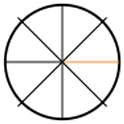
Marks printed in the corners and margin of a negative to precisely align several layers printed one after another on the same paper. Calibration Flow draws a registration target in each corner (a ring and 8 spokes crossing at the centre, in reserve inside a solid disc), an orientation key in the top-right corner (the ring and a dot, no spokes) that gives away a rotated or flipped sheet, and density wedges in the margin, one per ink. Particularly useful for multi-layer processes: Aquaprint CMYK, colour carbon printing (4 C/M/Y/K curves), multi-pass gum, colour screen printing. On a single-layer process (cyanotype, bromoil, gumoil, résinotype), the targets have nothing to align, but the margin wedge remains a print-control reference.
See also: Registration marks.
#Résinotype
A Vision Picturale process with a natural varnished finish. Chemistry: the S pouch (Résine) and VP N°03 Développeur, with a choice of black pigment — VP N°07 Noir Froid (PK7), VP N°11 Noir Chaud (PK11), or the duo of both. Prepared in a 40 °C water bath. Luminograph A3+ exposure: 3-6 min. Development in warm water at 30 °C, 10-15 min. Natural polymerization on final drying. dMax ~1.7. The only VP process that calls for a positive chart (positive interpositive).
See also: Test Chart module, Positive vs negative chart.
#Smart Analyzer
The tonal-intent classifier for the imported image. It reads the perceptual L* luminance distribution and assigns the image one of seven profiles (Normal, Low Key, High Key, Charcoal, Soft Mist, Underexposed, Uncertain), which automatically adapts the correction strategy proposed by the three sliders. The Smart Analyzer does not detect the chart's patches — centering the measurement zones is a separate function.
See also: Smart Analyzer.
#Spline (cubic)
A classic mathematical method for building a smooth curve passing through given points, in cubic segments with continuity of the derivatives at the joins. Calibration Flow does not use a cubic spline — the corrective curve is built by linear interpolation between thresholds, then smoothed with LOWESS + PCHIP. The term appears now and then in calibration literature but doesn't match this app's implementation. See Cubic polynomial for the details.
#UV (ultraviolet)
Electromagnetic radiation of a wavelength shorter than the visible (10 to 400 nm). Alternative processes that use UV exposure mostly rely on UV-A (315-400 nm) — the band of the Luminograph and tanning tubes. The sun emits UV-A in amounts that vary with the time of day and the season, which explains the difficulty of reproducibility under natural light.
See also: UV calibration.
A glossary in progress. If you're missing a term, flag it to support@picturale.app — we'll add it if you're not the only one who looked for it.